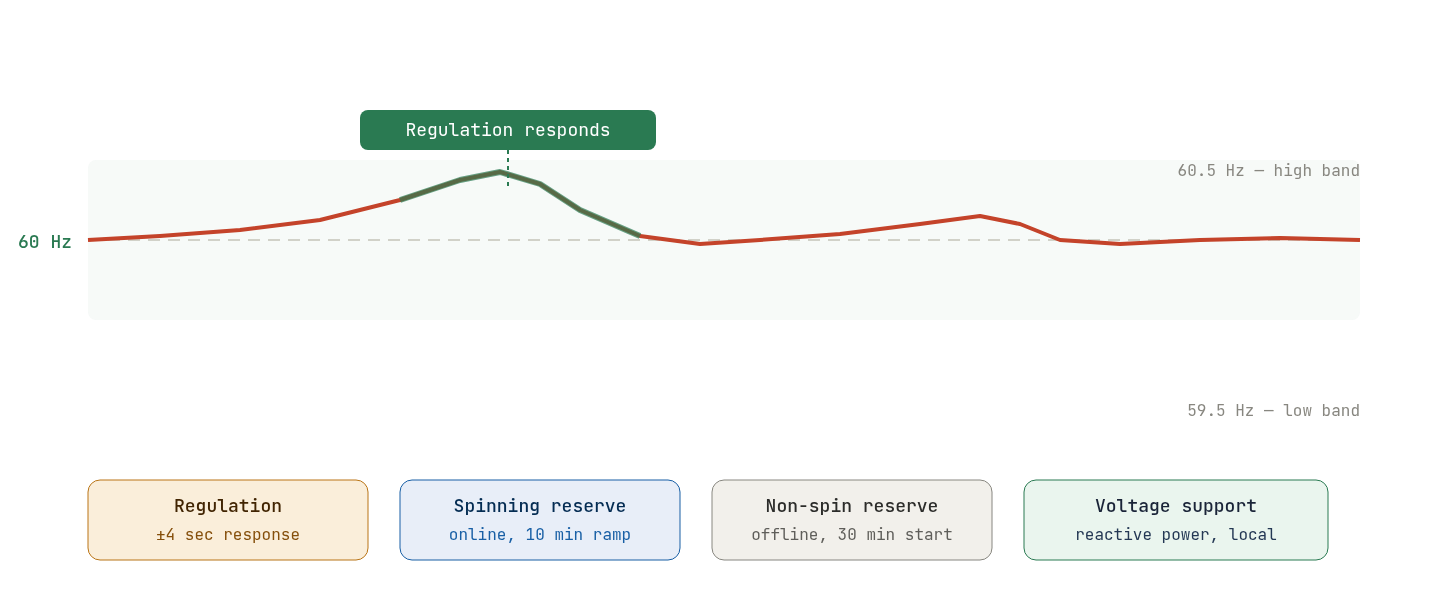
Ancillary services
Frequency regulation, spinning and non-spinning reserves — the second-by-second balancing services priced in their own markets.
Capacity market
A forward market where generators are paid to commit to being available during peak demand periods, regardless of whether they actually run. Ensures resour...
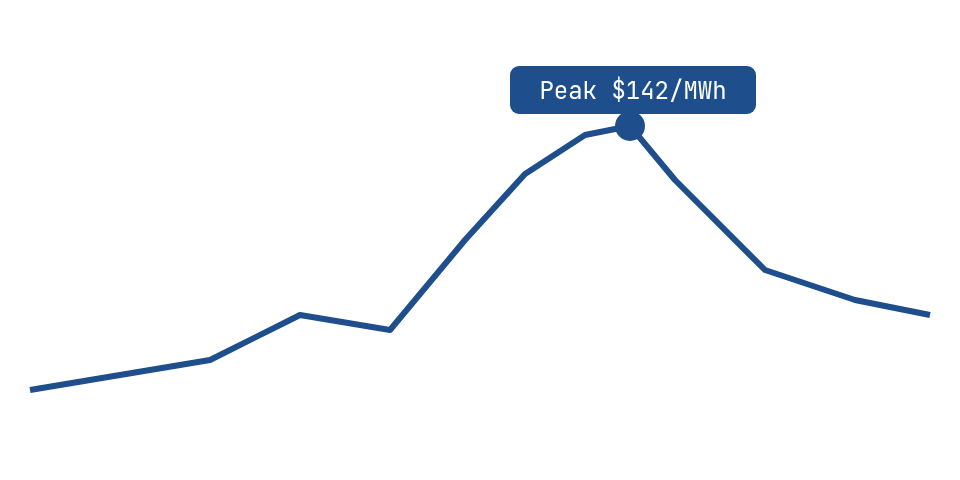
How electricity prices are set
Locational marginal pricing — what every wholesale settlement actually pays out. Energy + congestion + losses, why basis is the real exposure, and how FTRs hedge it.
Nodal pricing
A pricing approach that calculates a unique LMP at every node (bus) on the transmission network. Used by PJM, CAISO, MISO, NYISO, and SPP. Contrast with zo...
Heat rate
A measure of power plant efficiency — the number of BTUs of fuel required to generate one kilowatt-hour of electricity. A lower heat rate means greater eff...
Wholesale electricity market
A market where electricity is bought and sold in bulk between generators, utilities, and large customers before it reaches end consumers. Wholesale markets...
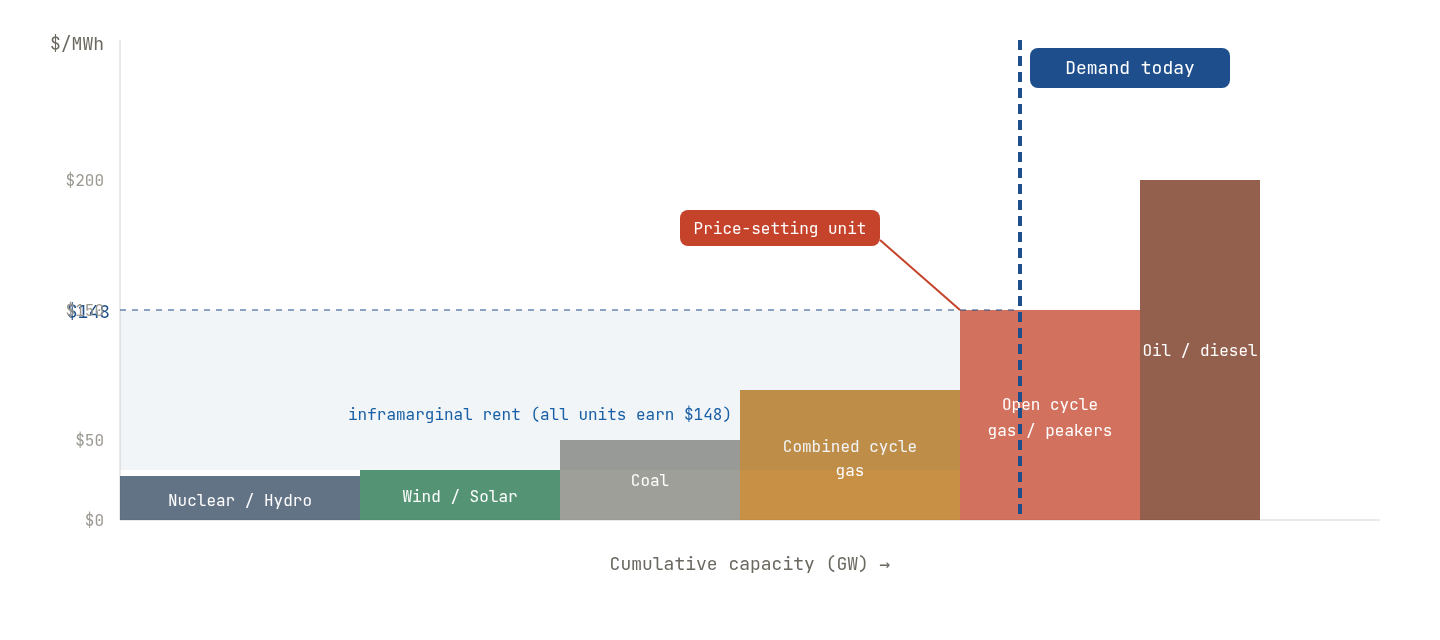
The merit order
The dispatch stack that sets the marginal clearing price every interval. Why high-renewable hours flatten the curve and create negative prices.
Congestion
A condition where transmission constraints prevent the lowest-cost generation from serving all load. Congestion adds to the LMP at constrained nodes and is...
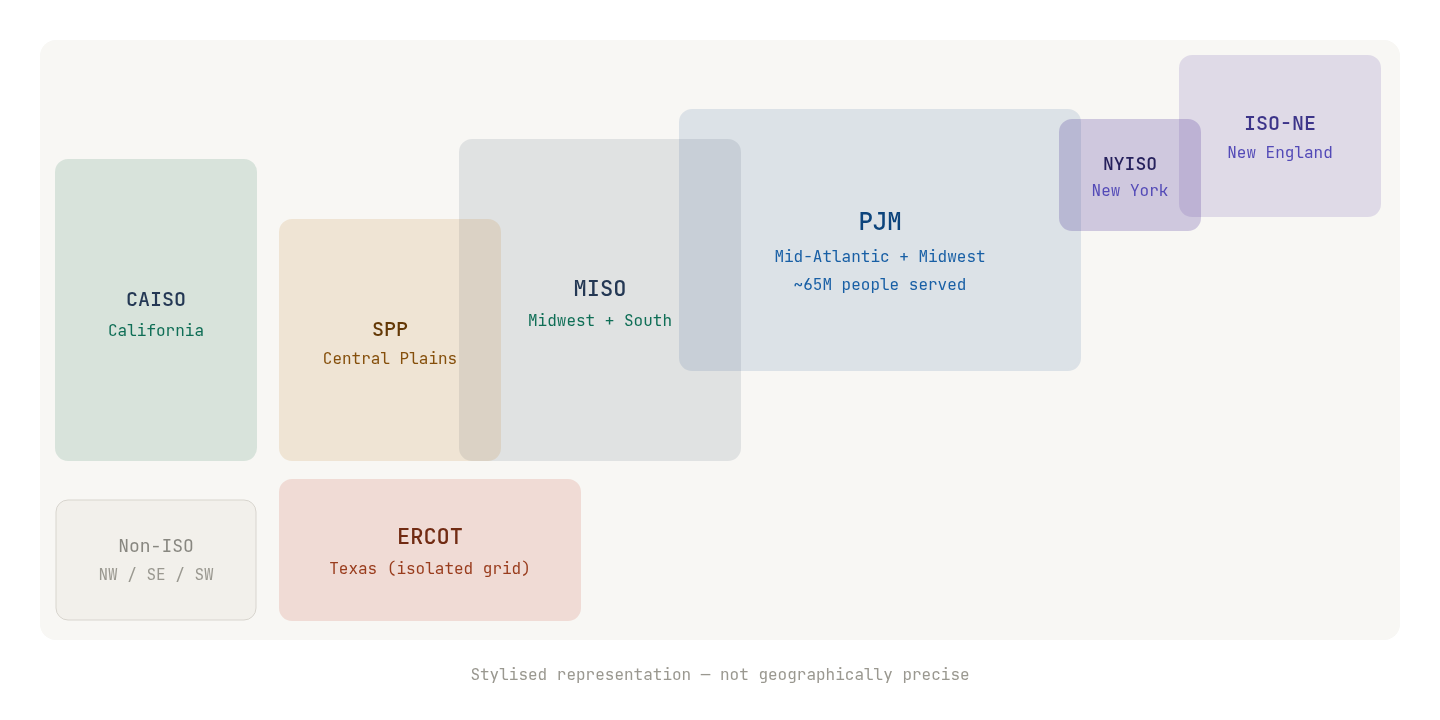
The ISOs and RTOs
Seven US ISOs run roughly two-thirds of the country's load. Market design differs sharply — energy-only ERCOT, capacity-market PJM, bilateral CAISO RA.
Scheduling coordinator (SC)
An entity certified by CAISO to submit schedules, bids, and meter data on behalf of market participants. SCs are the interface between generators, loads, a...
Financial transmission right (FTR)
A financial instrument that entitles the holder to a stream of revenue based on congestion charges between two points on the transmission grid. FTRs are us...
ISO / RTO
Independent System Operator / Regional Transmission Organization — the entities that manage the electric grid and operate wholesale electricity markets in ...
Merit order
The sequence in which power plants are dispatched, ordered from lowest to highest marginal cost of generation, until supply meets demand. Plants at the top...
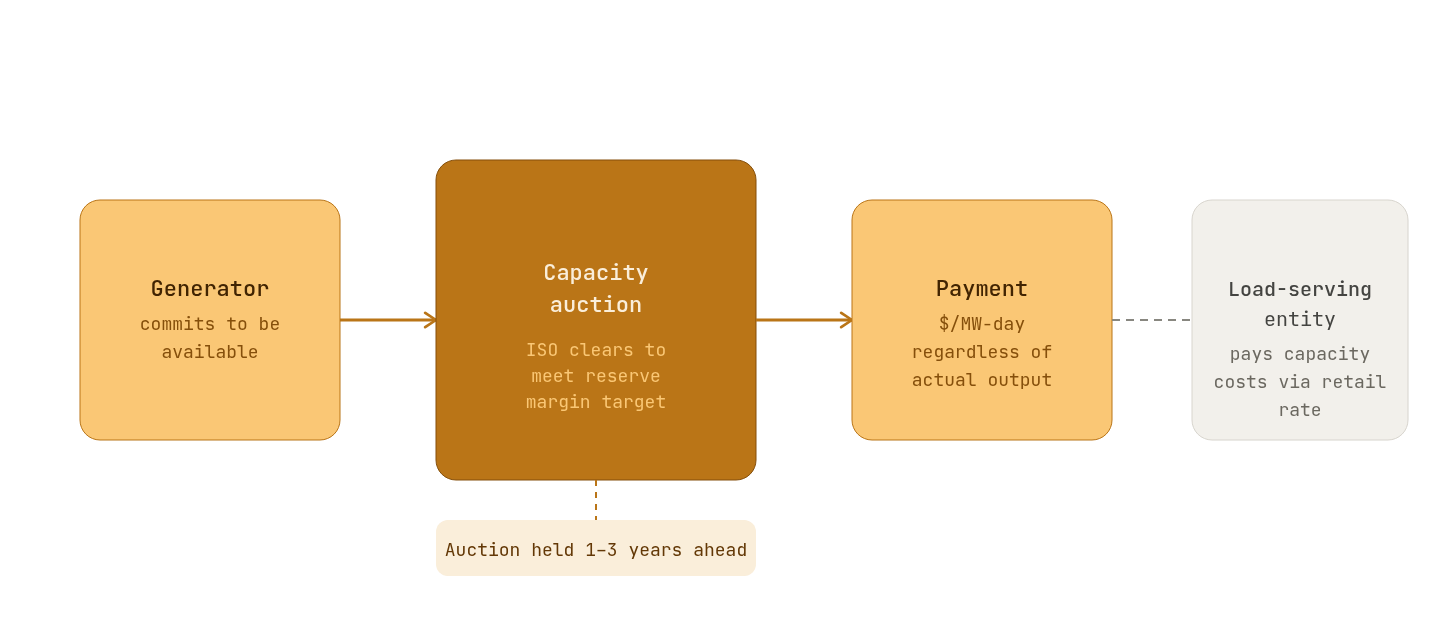
Capacity markets
Annual auctions paying generators to stay available. PJM cleared $333/MW-day in the 2027/28 BRA — the first time the entire RTO hit the FERC price cap.
Firm capacity
Generation or transmission capacity that is contractually committed to be available when called upon. Firm capacity commands a premium over non-firm becaus...
Zonal pricing
A market pricing approach that averages LMPs across a geographic zone rather than calculating a unique price at every node. ERCOT uses a hybrid approach wi...
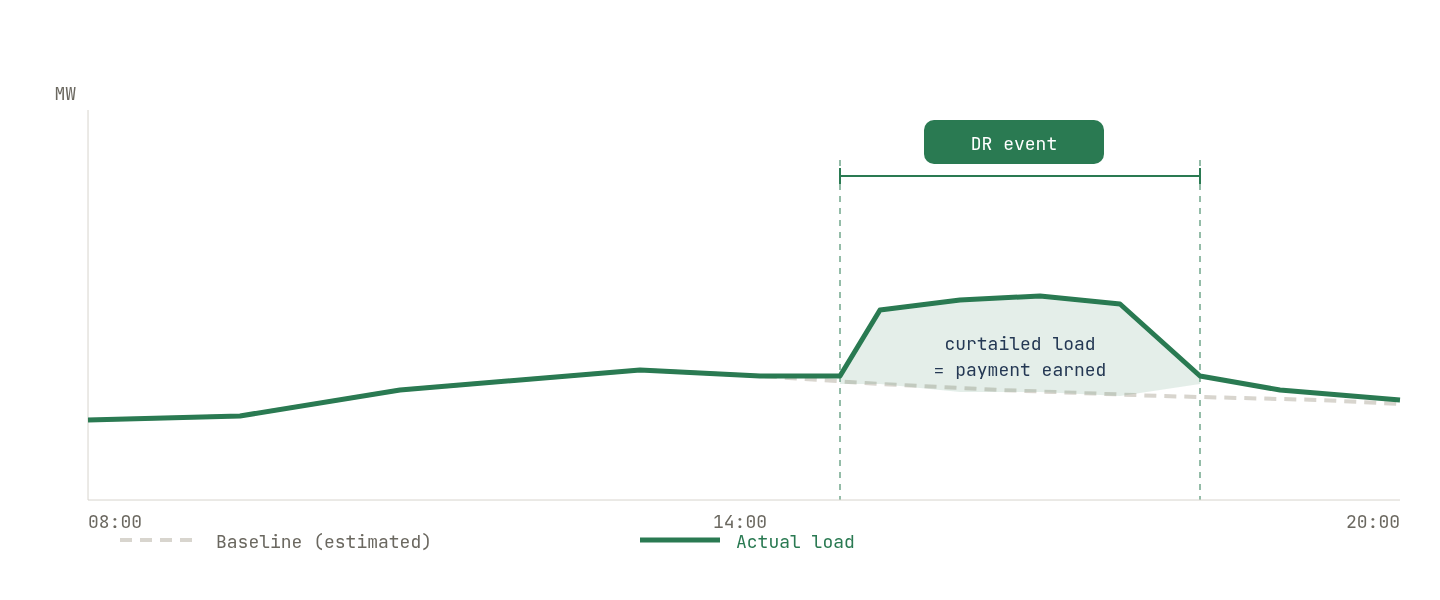
Demand response
Paying loads to curtail when the grid is short. How C&I programs are structured, what enrollment economics look like, and where performance penalties bite.
Resource adequacy
The requirement that a utility or load-serving entity maintain sufficient generation capacity to reliably serve its customers' peak demand plus a reserve m...
Locational marginal price (LMP)
The cost of supplying the next megawatt-hour of electricity at a specific node on the grid. Comprises three components: energy (system-wide marginal cost),...
Energy imbalance market (EIM)
A real-time market that automatically dispatches the lowest-cost energy to serve demand and correct supply-demand imbalances across a wide area. CAISO oper...
Real-time market
A spot market that clears every 5 minutes to balance actual physical supply and demand in real time. Real-time LMPs can deviate sharply from day-ahead pric...
Demand response
Programs that compensate electricity consumers for reducing or shifting load during high-price periods or grid stress events. C&I demand response can parti...
Day-ahead market
A forward market that clears prices one day before real-time delivery, typically by 1pm. Participants submit bids and offers; the ISO solves a network opti...
Basis risk
Exposure to price differences between a contract hub (like PJM Western Hub) and the actual delivery node where generation or load is located. Buyers settle...