If you’ve ever reviewed a commercial electricity invoice in a deregulated market like PJM, you’ve likely come across a line item that raises more questions than answers: capacity. It’s one of the most misunderstood, and increasingly one of the most expensive, components of your electricity cost. Yet understanding it is critical for any energy buyer looking to control spend and avoid surprises.
What is a Capacity Market?
A capacity market is basically a way to make sure there will be enough electricity available when it’s needed most. Instead of only paying power plants for the energy they produce, the grid also pays them to be ready and available during high-demand periods, like extremely hot or cold days.
At a high level, a capacity market is a forward-looking reliability mechanism. Grid operators like PJM don’t just pay for electricity that’s produced today, they also secure commitments from generators to be available in the future when demand peaks.1
In PJM, this system is called the Reliability Pricing Model (RPM), which ensures there is enough power supply to meet forecasted demand years in advance.2
Think of capacity as an insurance policy for the grid; it ensures electricity will be available during extreme conditions, even if certain resources are rarely used.1
Why Capacity Markets Exist
Electric grids must meet demand at all times, including during the highest-stress hours of the year.
The challenge is that:
- Some power plants only run a few hours annually
- Electricity demand can spike unpredictably
-
Electricity cannot be easily stored at scale
Capacity markets address this by ensuring enough resources are committed ahead of time, helping maintain grid stability and prevent outages during peak conditions.1
They also:
-
Encourage investment in new generation
-
Provide financial incentives for reliability
-
Ensure reserve margins are maintained3
How the PJM Capacity Market Works
PJM’s capacity market operates through a competitive auction process designed to match future supply with expected demand.
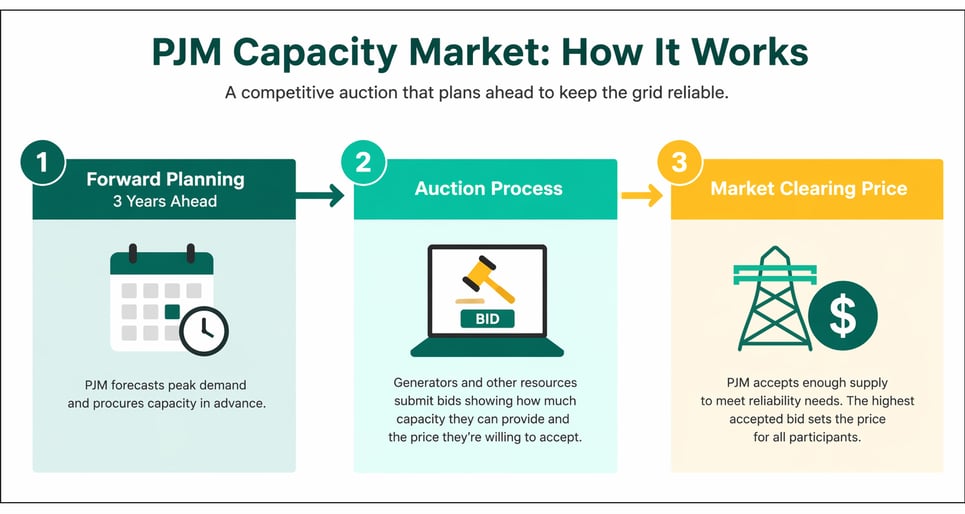
This structure creates a market signal:
-
Tight supply → higher prices
- Excess supply → lower prices
How Capacity Costs Show Up on Your Bill
This is where capacity becomes very real for energy buyers. Capacity charges can represent 20%-40% of total electricity costs for large commercial and industrial customers in PJM. This percentage represents a significantly larger share of total energy costs than what energy users paid even a few years ago.
Capacity costs are part of the supply portion of your electricity bill, flowing from wholesale market charges into retail pricing structures.4
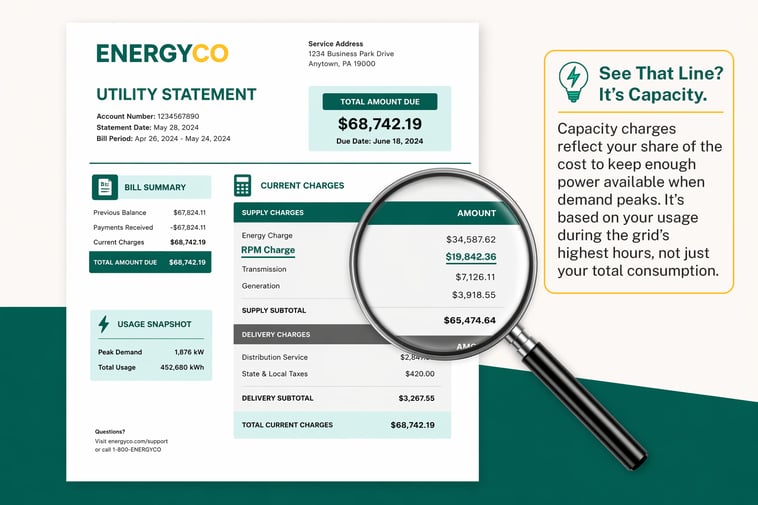
Unlike energy charges, capacity is largely driven by when you use electricity, not just how much. In PJM, your cost is determined by Peak Load Contribution (PLC):
-
PLC is based on your demand during the system’s highest peak hours
-
It determines your share of total capacity costs
In practical terms, if your facility uses more electricity during peak grid-stressed events, you will pay more in capacity costs the following year. These costs may be embedded in supply rates or passed through separately, but in either case, they can represent a significant portion of total electricity spend.4
What’s Driving Capacity Prices Higher?
Capacity pricing is fundamentally driven by supply and demand dynamics, and those dynamics are tightening.
Key drivers include:
-
Generator Retirements
-
Load Growth
-
Reliability Requirements
-
Market & Policy Changes
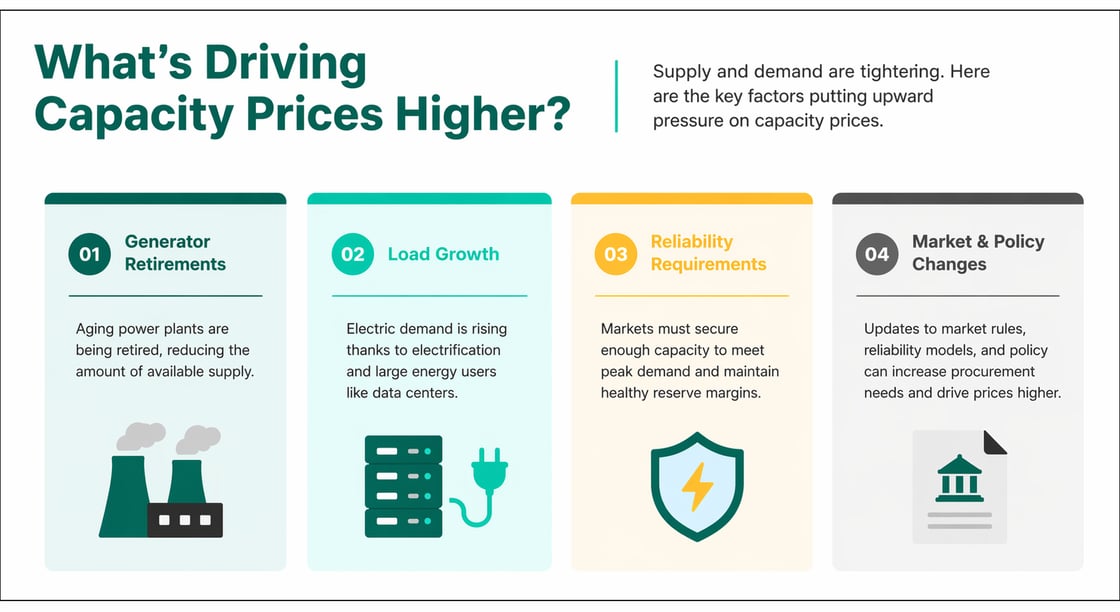
Changes to market rules and reliability modeling can increase procurement needs and pricing pressure.6 When supply tightens or demand increases, capacity prices rise, directly impacting customer costs.
Why Capacity Is So Misunderstood
Capacity behaves very differently from traditional energy pricing:
- It’s forward-looking, not real-time
- It’s based on peak demand, not total consumption
- It’s driven by a handful of hours per year
Because of this, many organizations don’t fully understand:
- Why their costs increased
- How their usage contributed
- Or how to control it
What Energy Buyers Can Do to Manage Capacity Costs
The good news: capacity exposure is not fixed, it can be actively managed.
-
Understand Your Peak Exposure
Analyze usage during historical peak hours to identify risk.
-
Manage Peak Load
Reducing demand during a few critical hours can significantly lower future obligations.
-
Structure Supply Contracts Strategically
Capacity risk can be passed through, fixed, or hedged depending on contract design.
-
Leverage Demand Response & Flexibility
Operational adjustments during peak periods can directly reduce PLC and future costs.2
Where Pilot Energy Fits In
Capacity markets are complex, but they don’t have to be unpredictable. Pilot Energy helps organizations turn this often-misunderstood cost into a strategic advantage by combining market expertise with data-driven insights. From forecasting capacity exposure and identifying peak demand risks to structuring smarter procurement strategies, Pilot Energy equips clients with the tools and guidance needed to proactively manage costs, rather than react to them.
The Bottom Line
Capacity markets exist to keep the grid reliable, but they also play a major role in what you pay for electricity.
Understanding how they work, and how your operations impact your exposure, is no longer optional. It’s a competitive advantage. As capacity prices rise across markets like PJM, organizations that proactively manage this cost will be the ones that stay ahead.
Ready to see how your energy strategy stacks up?
👉 Take the Energy Readiness Assessment
👉 Request a Consultation or Discovery Call
About Pilot Energy
Pilot is an energy advisory and procurement partner helping businesses manage rising energy costs with confidence and clarity. Founded in 2001, we provide independent, data-driven strategies for energy procurement, energy risk management, utility cost reduction, and long-term commercial energy savings.
We work closely with finance, operations, and sustainability teams to create custom energy roadmaps, aligning energy procurement, forecasting, and carbon reduction goals. With a blend of market expertise and digital platforms, we help you reduce volatility, improve budget predictability, and plan smarter in any market.
Schedule a complementary energy assessment and a no-cost utility bill review with Pilot Energy today and start building a smarter energy strategy.
Sources
1 Federal Energy Regulatory Commission (FERC) – Introductory Guide to PJM Processes
https://www.ferc.gov/introductory-guide-participation-pjm-processes
2 PJM Interconnection – Reliability Pricing Model (RPM)
https://www.pjm.com/markets-and-operations/rpm.aspx
3 U.S. Energy Information Administration (EIA) – Electricity Explained: Markets
https://www.eia.gov/energyexplained/electricity/electricity-markets.php
4 Maryland Office of People’s Counsel – FERC and PJM Issues
https://opc.maryland.gov/Consumer-Learning/FERC-and-PJM-Issues
5 PJM Interconnection – PJM Interconnection Overview
https://www.pjm.com/about-pjm
6 Philadelphia Net Zero – PJM Capacity Prices Overview
https://www.phillynetzero.org/blog/pjm-capacity-prices